Downtown
RVA Legends — Good Luck! Part 4
A look into the history of Richmond places and people that have disappeared from our landscape.


This is where the story gets ugly. Enter William Ziegler, and the internecine activities of the Royal Baking Powder Company.
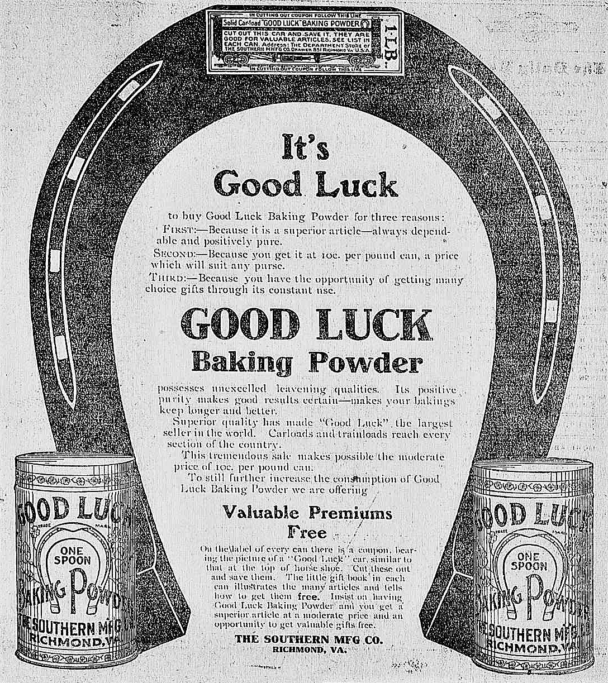
(LOC) — Daily Press — April 8, 1905
Egbert G. Leigh, Jr. took Southern Manufacturing Company to an industry-leading position from the manufacture and sale of Good Luck Baking Powder, using an alum-based formula.
Only, the baking powder makers using the original Cream of Tatar-based formula Were Not Amused. Quite the opposite, and the dirty tricks they used to fight back are part of the reason we have the Federal Trade Commission today.
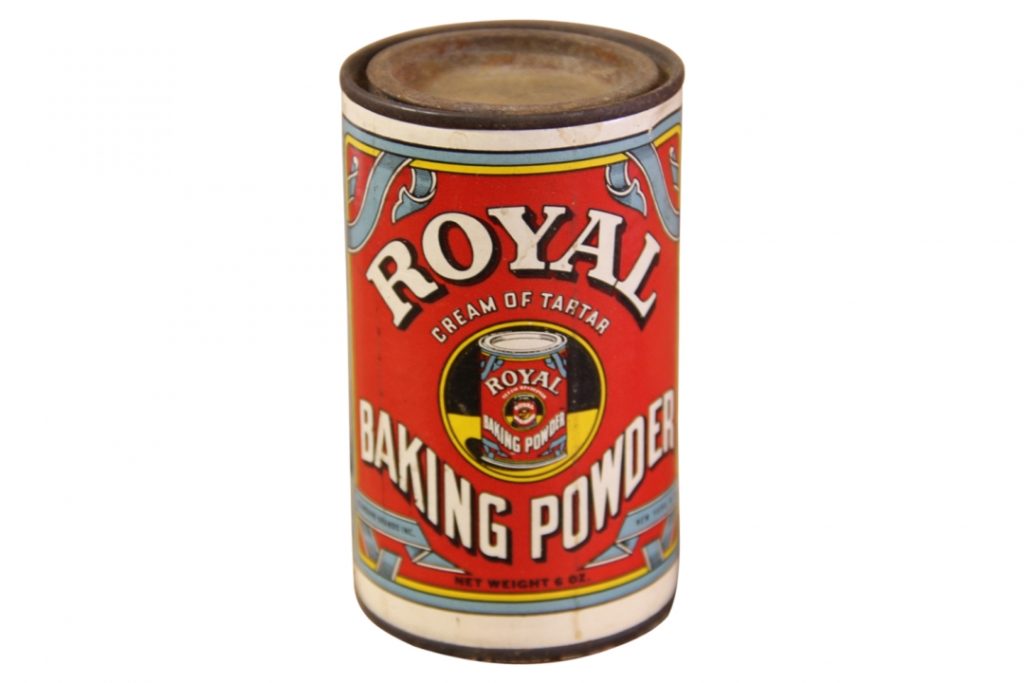
Two companies, both named Royal, dominated the market. One firm was owned by William Ziegler, the other by the Hoagland family. When a lawsuit was unable to determine which company was entitled to the name, the companies merged, becoming the Royal Baking Powder Company. [POP]
Ziegler gained a controlling interest, and eventually acquired other smaller baking powder firms.
He combined in a trust, the Cleveland, Price, and Royal cream of tartar companies; their separate capitalization amounted to something over one million. The trust was capitalized at $20,000,000. [BPC1]
The firm soon faced competition from new companies that used tartaric acid, calcium acid phosphate, aluminum phosphate, and sodium aluminum sulfate as the acids in their preparations. These products were called alum powders, even though they did not actually contain alum. They were cheaper to make and frequently sold for one-fifth the price of Royal’s cream of tartar powders. Royal dominated the cream of tartar industry but was facing over 500 competitors that made alum powders. [POP]
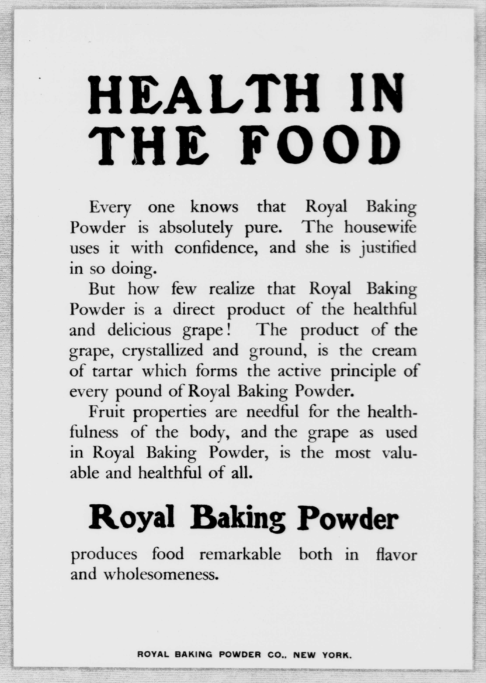

Ziegler chose not to play nice, fighting to sustain a monopolistic advantage. First, there was an advertising campaign, meant to drive home two specific points, namely that
- Royal Baking Powder was a wholesome, natural food, just the thing that a sensible housewife would want in the household to feed the family
- Alum-based baking powder was harmful, unhealthy, and dangerous
He began the war by hiring chemists to give “expert opinions” against alum and for cream of tartar. The alum people, in alarm had to hire chemists to give opposite opinions for alum and against cream of tartar. What the merits of the chemical controversy are, no man can decide now. Hundreds of “eminent scientific men,” chemists, physiologists, and doctors of medicine, have taken part in it and there are respectable authorities on both sides. The Royal’s array of experts, who say “alum is bad,” is the greater, and they are right as to “alum in food.”
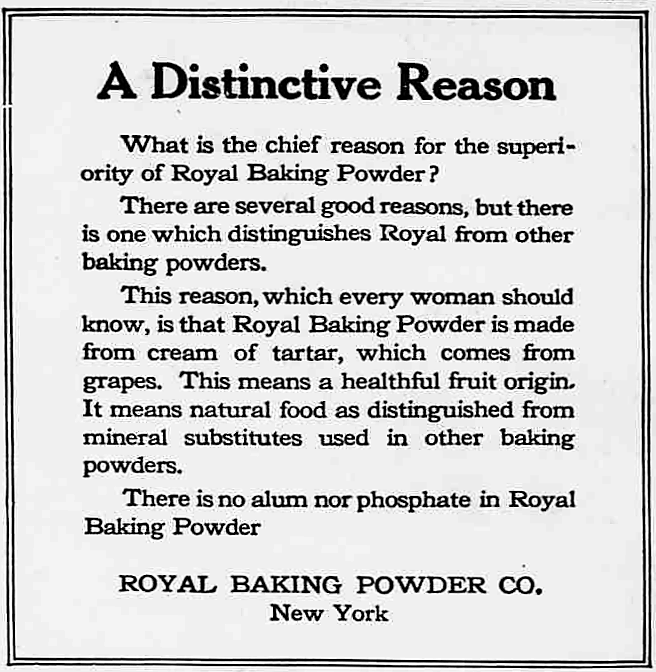
(LOC) — The Williams News — October 19, 1916
But that is a trick phrase. The alum people say, and truly, that the alum in baking powder disappears in the bread, just as cream of tartar does, and that the whole question resolves itself into the effects on the human system of what is left. In the case of the alum, the residuum is hydrate of aluminium, of which Dr. Austin Flint, who experimented with Prof. Peter F. Austin and Dr. E. E. Smith*, says that it “is inert; has no effect upon the secretion of gastric juice, nor does it interfere with digestion; and it has no medicinal effects.” On the other hand, the alum party say that the residuum of cream of tartar powder is ‘Rochelle salts, an irritant drug with purgative qualities.“ This the Royal overwhelmed with testimony, but Ziegler does not believe much in defense, he attacks. His was a war on “impure food,” and his slogan was short and sharp; “alum, a poison.” That was all. [BPC1]
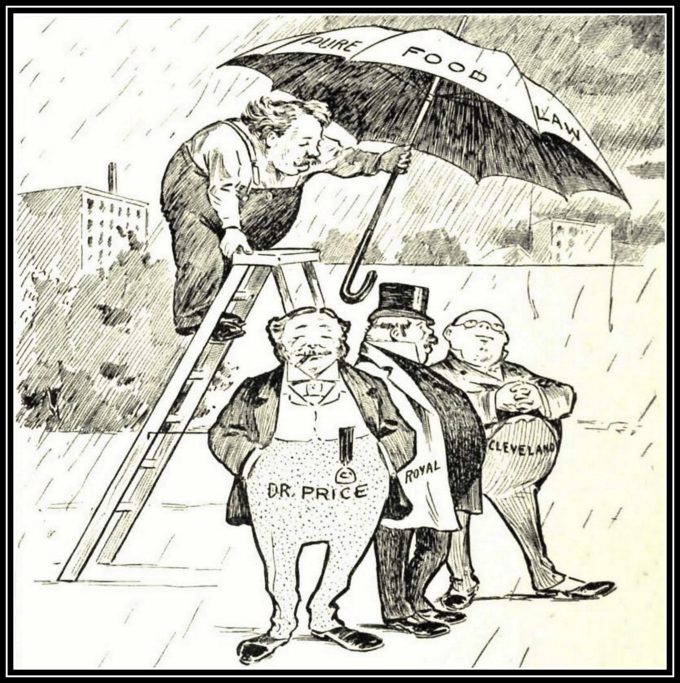
[BPC2] — The Ketallers’ Journal — July 1, 1899
In the State of Virginia the assault was made so acutely and so sharply that the legislature turned around, and when they passed a pure-food bill they put in an express provision that alum baking powder should be excluded from the operation of the law. The legislature of Virginia was amazed at the audacity of a corporation which would dare to press such a proposition. [BPC1]
But pass it they did, and not just in Virginia. Caught flat-footed, the alum baking powder makers, including Southern Manufacturing, formed the American Baking Powder Association in self-defense.
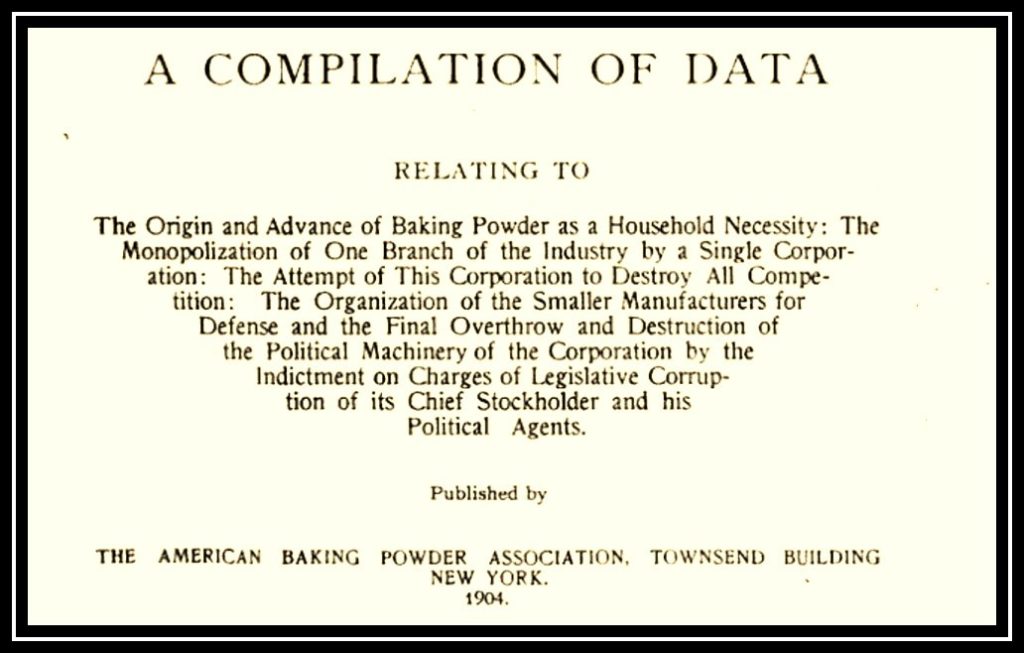
[BPC1] — 1904
Mr. Morrison states that the cream of tartar baking powder people succeeded in passing a law in Missouri which would throw 31 alum factories out of business. The bill was passed without the knowledge of the alum baking powder manufacturers. Since that time every legislature which has met has had the bill presented to it, but the American Baking Powder Association has always shown its purpose, and has in every case been successful in defeating it. In the Virginia pure food law a provision was inserted that alum baking powder should be excluded from the operation of the law. Mr. Udell says the animus behind every bill introduced into State legislatures, so far as he knows, has been to strike down industries not controlled by the Baking Powder Trust. [BPC1]
The gloves were off, and it would get worse still.
(exciting conclusion to follow!) (read part 3)
Sources
- [BPC1] The Baking Powder Controversy, Volume I. A. Cressy Morrison. American Baking Powder Association. 1904.
- [BPC2] The Baking Powder Controversy, Volume II. A. Cressy Morrison. American Baking Powder Association. 1904.
- [POP] The Politics of Purity: Harvey Washington Wiley and the Origins of Federal Food Policy. Clayton Anderson Coppin and Jack C. High. 1999.
* Dr. E.E. Smith is better known to science fiction fans as E.E. “Doc” Smith, quintessential author of the Space Opera, including the Lensman and Skylark of Space series.
 RVA Legends is a regular series
appearing on rocket werks – check it out!




Savory Grain Closing this Sunday

Virginia Opera brings Pagliacci to the Carpenter Theatre on Nov. 13 and 15

Photo of the Day: Where Eagles Dare

The War on Cars Strikes on Election Day

Squirrel-O-Ween Flies into CarMax Park on Friday

Richmond musicians pay tribute to Dolly Parton at Get Tight Lounge on Oct. 10

University of Richmond lands record $150 million gift as it launches $600 million campaign

Hardywood and Starr Hill are officially one company, and neither brand is going anywhere

Richmond region visitor spending hits a record $4.1 billion in 2025

The Byrd Theatre screens the 1925 ‘Phantom of the Opera’ with a live Wurlitzer score on Oct. 25