Downtown
RVA Legends — Good Luck! Part 3
A look into the history of Richmond places and people that have disappeared from our landscape.


Success requires expansion! (and reverse osmosis)
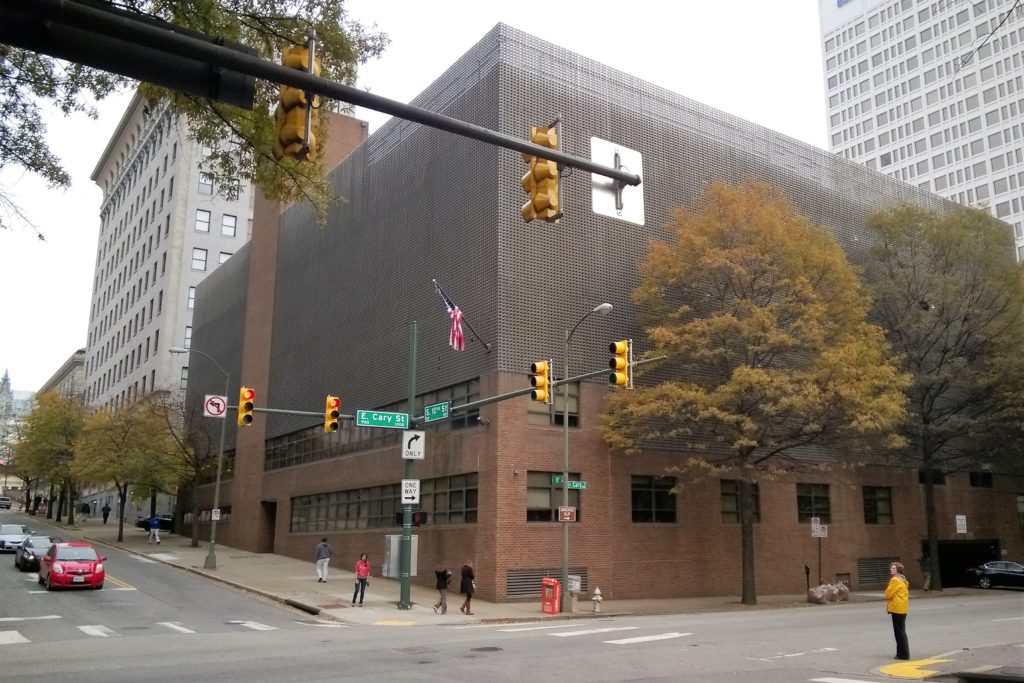
November 2016 — Tenth & Cary Streets, Richmond
Good Luck Baking Powder was the sword that made Southern Manufacturing Company’s fortune.
In the late 1890s the Journal of Progress in New York reported that eighty workmen were employed with making cans, a regiment of carpenters were making boxes for packing and twenty “hustling” salesmen were out telling of the wonders of Good Luck Baking Powder. The daily output was listed as 50,000 cans, equal to about 1,000,000 pounds a month. The article was the result of a shipment that also had been featured in an ad in the Dispatch of November 26, 1897 picturing a twenty seven-car load of Good Luck baking powder on its way to Atlanta and other stops in Alabama and North Carolina. It was the largest sale of baking powder made in the world. [BBR]
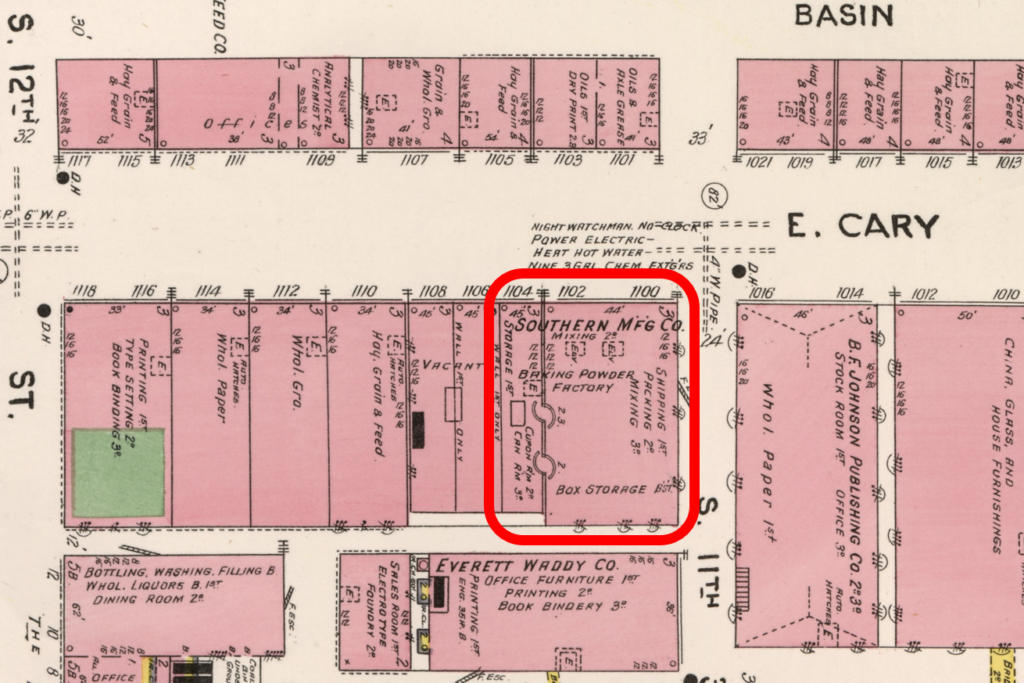
(LOC) — Sanborn Fire Insurance Map from Richmond (1905) — Tenth & Cary Streets, Richmond
So, just six short years after its founding, Egbert Giles Leigh, Jr. takes the company to being the industry leader. That’s like an amateur qualifying for the Tour de France, then beating Lance Armstrong. Pretty incredible; no wonder they had to expand.
What’s even more interesting is that the expansion occurred into Richmond from Manchester, not the other way around. In those days, many Manchesterians traveled by ferry or bridge to jobs in the city. Nor was it unusual for Richmond businesses to expand southward into Manchester, as observed by both the Stephen Putney, and Wingo, Ellett, & Crump shoe companies.
Southern Manufacturing Company was Manchester born and bred, and expanded north — unusual for the time.
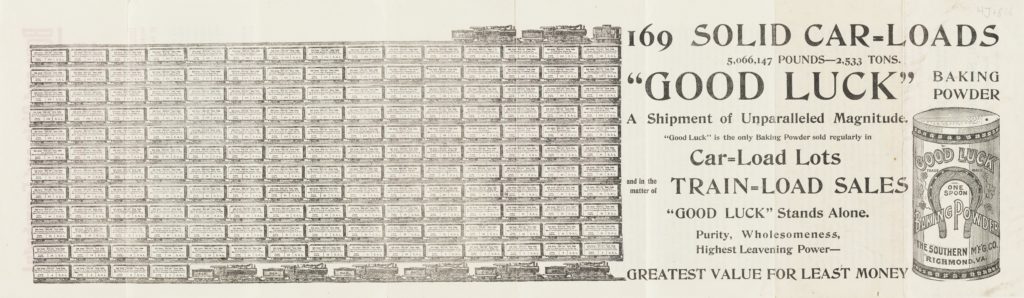
[Library of Virginia] — [BGE] — 1900
One of the largest and most successful manufacturing concerns of its kind in Virginia is The Southern Manufacturing Company, whose transactions cover the tremendous area of twenty-six States. With its force of about thirty traveling salesmen, this company has the largest baking powder output in the country. With its two factories, in located at Manchester, the other, its can factory, in this city, the volume of business done by this concern may be easily imagined. [PSS]
In fact, what had been the biggest sale of baking powder in 1897, was blown away just three years later with a shipment of 169 car loads – a growth of 525%. What CFO wouldn’t like those numbers?
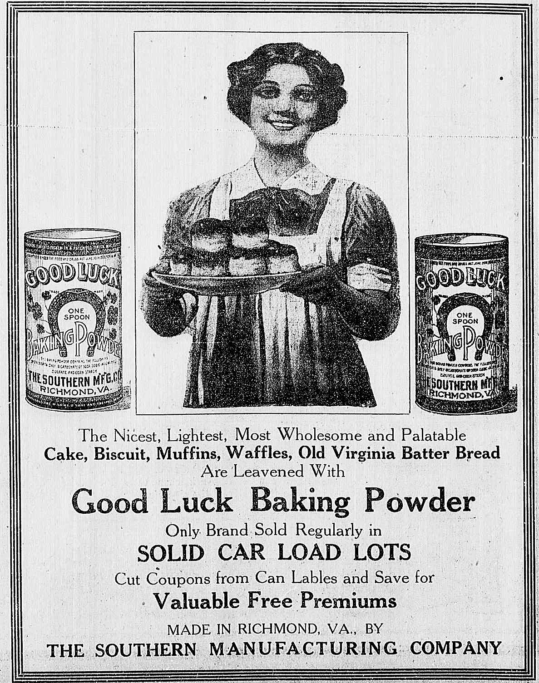
(LOC) — Times-Dispatch — Sunday, March 30, 1913
A booming business needs advertising, a task Southern Manufacturing accepted with aplomb… and some mixed results.
Newspaper advertising was a primary medium for reaching consumers, and Good Luck Baking Powder was well represented. Naturally, ads appeared in the Richmond and Williamsburg papers, but they could also be found in several other states, including Texas, Oklahoma, Mississippi, and others.
Probably damned effective too. Who could say no to the Siren of the Biscuit Plate? Even in black and white, those things look like good eating. Nom, nom, nom!
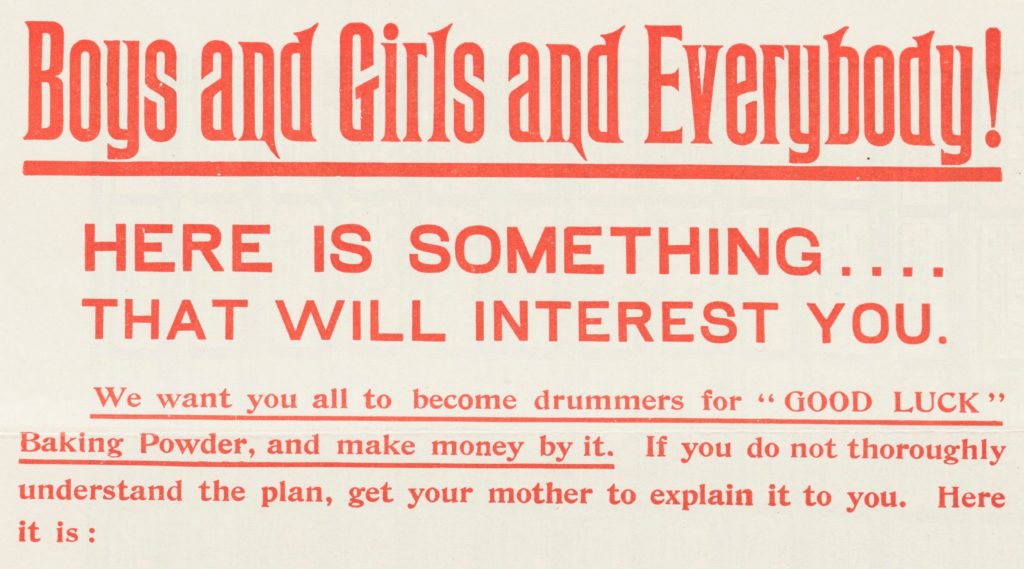
[Library of Virginia] — [BGE] — 1900
In every six-ounce can of Good Luck we are now putting a section (a piece) of a picture of a Trainload of Good Luck; and in every sixteen-ounce can we are putting two of the sections. A “section” of the picture means a piece of it. The sections of the picture of the 105-car train are numbered on the back from 1 to 105 inclusive; and those of the 169-car train are numbered from 151 to 319 inclusive Don’t get the number of the section, which is printed at the top left-hand corner on the back, confused with the number on the car door. The same quantity of each section is packed in the cans, and no section is missing from the output.
Here are the various offers we make for the sections:
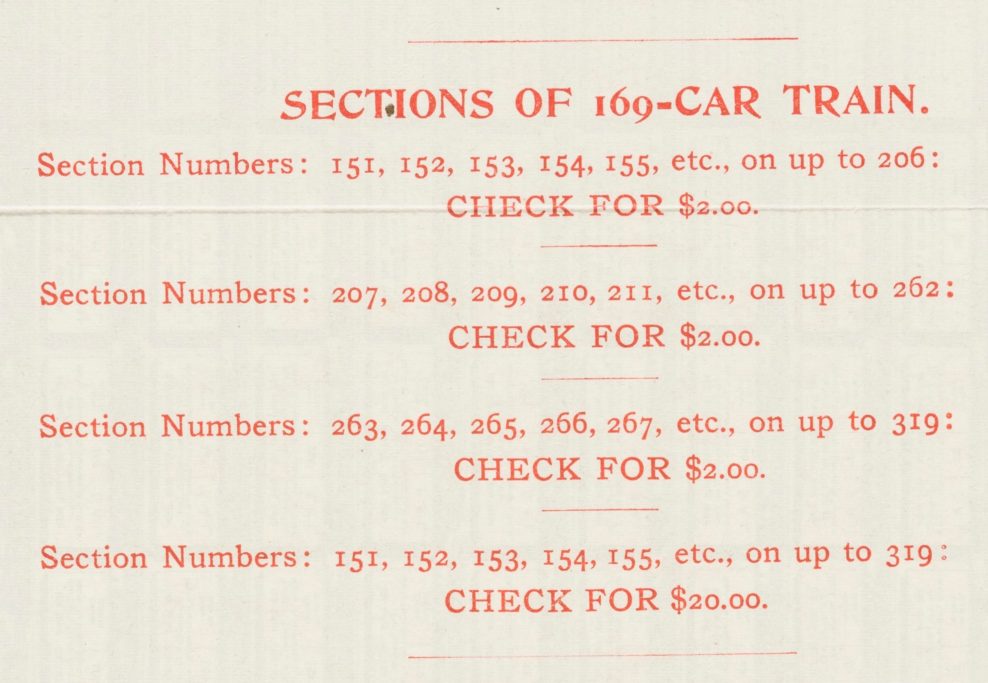
[Library of Virginia] — [BGE] — 1900
What could be simpler? Remember:
This plan is not confined to any age; any person from eight years old up should be able to secure good results. Now is the time to hustle.
Hustle sums it up nicely. Imagine being the manager who’s on the hook for this, making sure that:
- the right tokens got in the right cans
- there are enough tokens to represent all the sections for both car trains
- the 6-ounce can got one token, and the 16-ounce can got two
- there was an even distribution of tokens across the different cans
That sounds awful complicated for a promotion with a time limit, in an age where automation to support it was limited. It’s not hard to imagine someone going cross-eyed trying to make it work.
We will be glad to co-operate with you as much as possible, and can probably assist you some by letter.
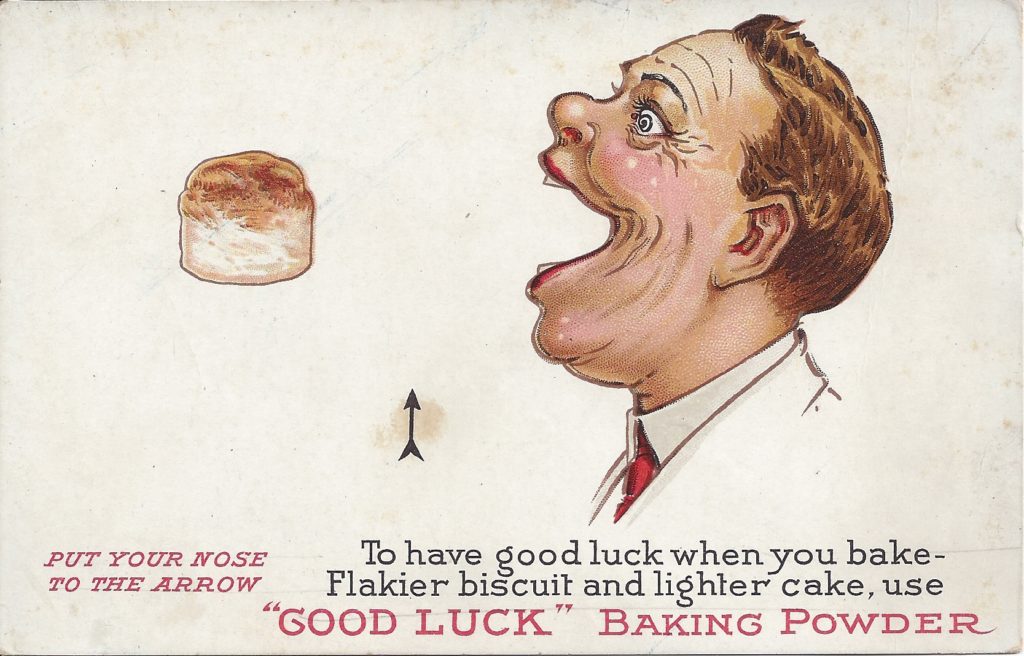
And then there were the postcards.
When the U.S. Post Office first issued postal cards in 1873, they were nothing like what they are today, basically white cards for short messages that could be mailed for a penny. It wasn’t until 1893 that U.S.P.O permitted the first picture post cards to travel by mail, and not until 1907 that post cards had the now familiar divided back, with one side for the address, and one side for the message. By then, the U.S. was in the heyday of postcard popularity, with 667,777,798 mailed in 1908 alone. [AOV]
Southern Manufacturing was quick to notice this trend, and produced some… interesting… cards of their own. The first post in this series depicts one of these, oh so very Southern, and well in keeping with a clean-cut company image.
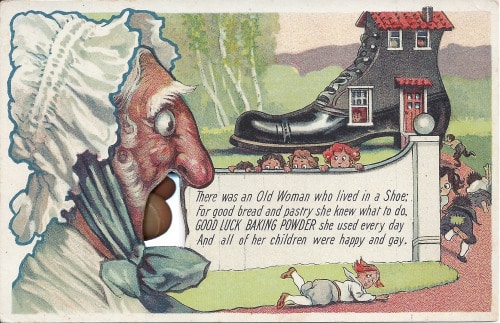
But someone at the company had a sense of humor, because there were others made that were playful novelties. Not to mention a little creepy.
Go ahead, find a private corner, and put your nose to the arrow of the biscuit card above. Watch it fly into his mouth, and try not to smile. Or put your thumb and forefinger behind the Old Woman card to form her mouth, then wiggle them to make like she’s eating.
Yucks galore!
As many commercials prove today, there’s nothing like a good laugh to make sure that the audience remembers your product. At the time they were issued, Southern Manufacturing needed all the help it could get.
(continued in Part 4) (read Part 2)
Sources
- [AOV] Art of the View. Virginia Cavalcade, Volume 40, Number 2. Kelly Henderson. Autumn, 1990.
- [BBR] Big Business in Richmond, The Good Luck Baking Powder Story. Ray Schreiner. June 2010.
- [BGE] Boys and Girls and Everybody! Southern Manufacturing Company. 1900.
- [RVCJ] Richmond, Virginia, the City on the James. The book of its Chamber of Commerce and principal business interests. G. W. Engelhardt. 1902.
 RVA Legends is a regular series
appearing on rocket werks – check it out!




Savory Grain Closing this Sunday

Virginia Opera brings Pagliacci to the Carpenter Theatre on Nov. 13 and 15

Photo of the Day: Where Eagles Dare

The War on Cars Strikes on Election Day

Squirrel-O-Ween Flies into CarMax Park on Friday

Richmond musicians pay tribute to Dolly Parton at Get Tight Lounge on Oct. 10

University of Richmond lands record $150 million gift as it launches $600 million campaign

Hardywood and Starr Hill are officially one company, and neither brand is going anywhere

Richmond region visitor spending hits a record $4.1 billion in 2025

The Byrd Theatre screens the 1925 ‘Phantom of the Opera’ with a live Wurlitzer score on Oct. 25