History
Must-See RVA! — Children’s Home Society of Virginia
A look into the history of Richmond places that are still part of our landscape.

AKA, Maybee House
2605 East Franklin Street
Built, 1859
A former orphanage, right on top of Church Hill.


(Children’s Home Society of Virginia) — Our Receiving Home and Central Office, 2605 East Franklin Street, Richmond, Va.
The Children’s Home Society of Virginia was organized in 1899, and chartered by the General Assembly on 30 January 1900. Inspired by the work of the National Children’s Home Society, it was born of concern on the part of its founders for the plight of abandoned and neglected children. As stated in its charter, the Society’s goal was “finding family homes for homeless, indigent, or dependent poor children in the State of Virginia, and other purposes incident thereto.”

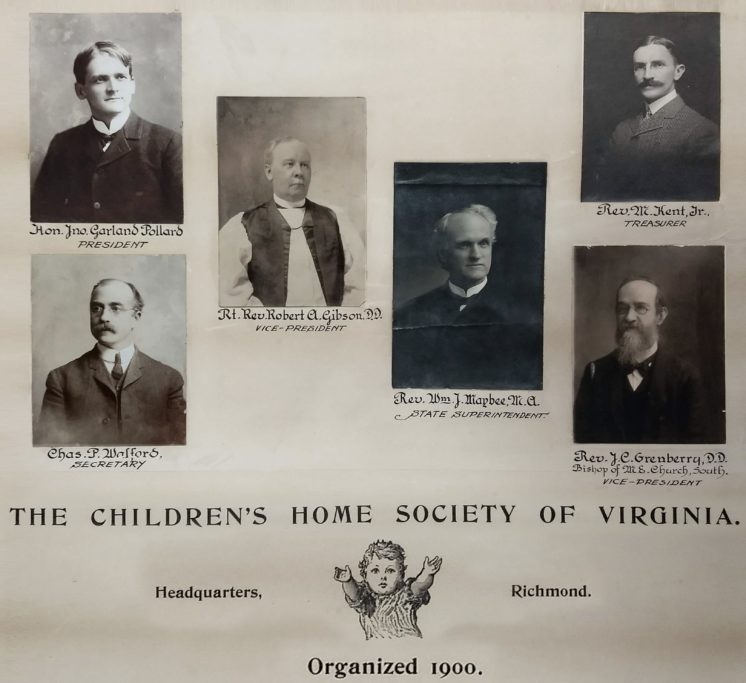
(Children’s Home Society of Virginia) — Children’s Home Society of Virginia first Board of Directors
The Board of Directors selected John Garland Pollard as the Society’s first president and the Reverend William J. Maybee as state superintendent. Maybee, who was to hold that position for nearly 30 years, articulated the ethos of the Society when he wrote in 1903 that “We are not to imagine that children of humble birth are therefore inferior, on the contrary the homeless child of the street is of the same clay as the petted darling of the wealthy…Both Christianity and civilization may be quite correctly measured by their treatment of childhood.”

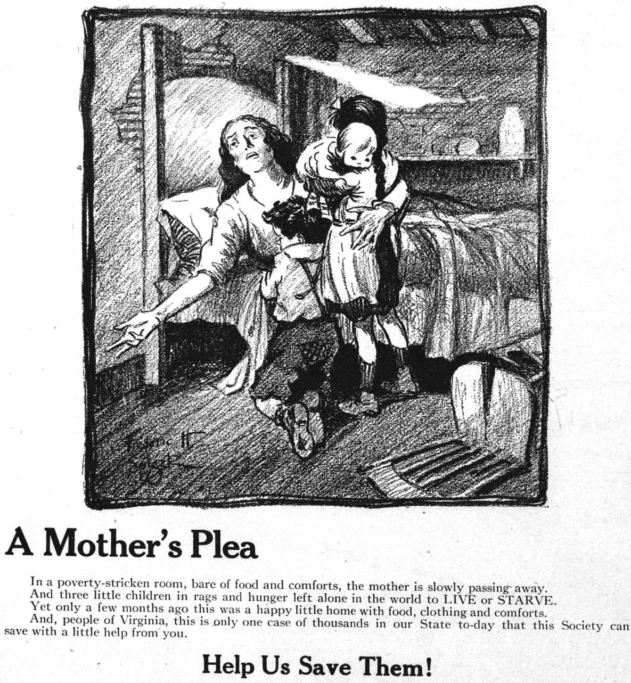
(Chronicling America) — advertisement for Children’s Home Society of Virginia in The Presbyterian of the South — June 25, 1919
The Society received children in one of two ways, parental placement or court commitment. Representatives of the CHS traveled the state gathering children who were made wards of the Society and brought them back to Richmond. The children then underwent “a thorough system of renovation” that included the provision of “clean and comfortable garments,” basic etiquette training, and examinations by medical and psychological doctors.


(Chronicling America) — advertisement for Children’s Home Society of Virginia in Richmond Times-Dispatch — Sunday, June 8, 1919
Initially, wards were placed under the care of Rev. Maybee’s wife, Mary McLeod Maybee, and the Belle Bryan Day Nursery. In 1905, the Board purchased a house at 2605 East Franklin Street to serve as a receiving home and central office; another receiving home was opened in Roanoke in 1920. Local advisory boards around Virginia handled much of the recruitment and screening of foster families, and helped monitor foster placements. Those children who were never adopted remained the responsibility of the CHS until they reached adulthood, became self-supporting, or married.

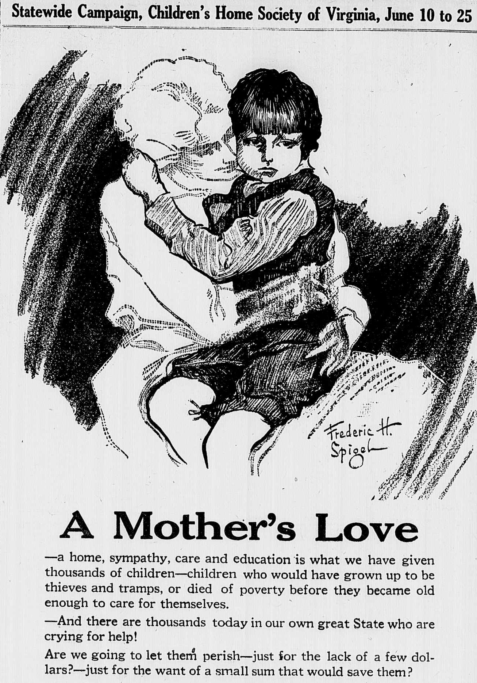
(Chronicling America) — advertisement for Children’s Home Society of Virginia in Richmond Times-Dispatch — Sunday, June 15, 1919
Change came to the Society in 1926 when it joined the Child Welfare League of America and began a process of reorganization based on League observations. Their recommendations touched on a variety of areas including fire safety in the receiving homes, hygiene, nutrition, record-keeping, the manner of disciplining the children, the selection of foster homes, and other topics. One major adjustment resulting from the study came with the shift to a staff of trained social workers.


(Library of Virginia) — Virginia Historical Inventory Photographs, Works Progress Administration Collection — 1937
With its budget coming entirely from donations (and, starting in 1930, from the Richmond Community Fund), the Society struggled financially in its early years. By the early 1930’s it was in danger of closing under the weight of $50,000 in debt. Led by then-Governor John Garland Pollard and other prominent supporters, the state-wide “Spring Emergency Campaign” of 1931 yielded enough funds to erase the Society’s debt and bring a measure of financial stability. The Society later partnered with the United Way for several years as an additional source of funds.
The receiving home was closed in 1934, signaling the Society’s move to an emphasis on temporary boarding home (foster) care in advance of permanent adoption placement. (Children’s Home Society of Virginia)


(Library of Virginia) — Virginia Historical Inventory Photographs, Works Progress Administration Collection — 1937
Madge Goodrich researched this house in 1937 for the Works Progress Administration of Virginia.
The Children’s Home Society of Virginia was an orphanage. The society owned the house from 1905 till 1921. It was conducted for a number of years by Dr. Mabie (sic), who later moved the orphanage to Highland Park. The house is often spoken of as the Mabie House, from this fact. The children were under the age of twelve and four. The house being too small for their numbers, the Society rented a part of the house at the west for about five years.
Although Madge was not able to determine a date, the City of Richmond calls it at 1859, so we’ll roll with that. She does note that it was owned by Hector Davis at the time, and sold the following year to Alexander Walker. (Library of Virginia)
The Children’s Home Society of Virginia is still going strong, now performing their worthy function in the Near West End on Fitzhugh Avenue.
(Children’s Home Society of Virginia is part of the Atlas RVA! Project)


Must-See RVA! is a regular series
appearing on rocket werks – check it out!

