Downtown
Must-See RVA! — Joseph P. Winston House
A look into the history of Richmond places that are still part of our landscape.

AKA, Winston House
103 East Grace Street
Built, 1873-1874
VDHR 127-0222
Joseph P. Winston & Co.
101 South Fourteenth Street (AKA, 101 Pearl Street)
Built, 1870
The lonely house on East Grace.
The Joseph P. Winston House is significant to Richmond’s architectural history as one of the few remaining 19th-century residential structures on now highly commercial Grace Street.

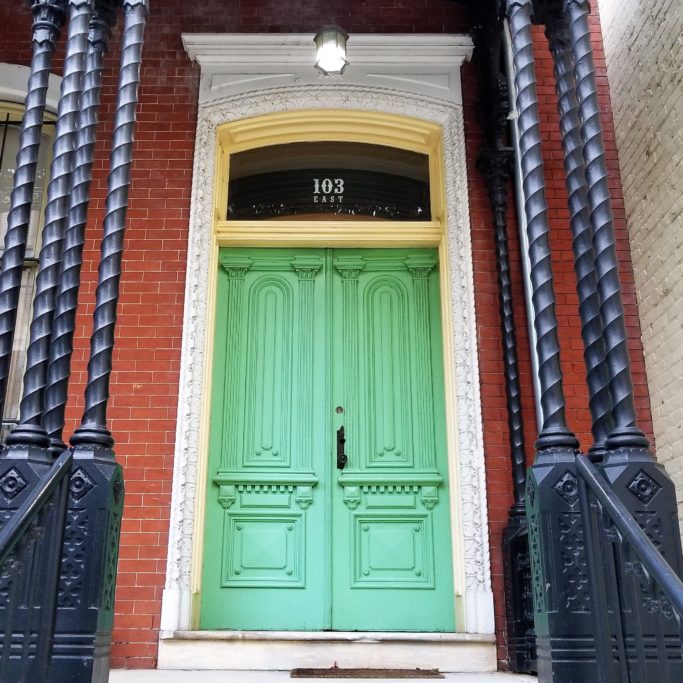
October 2018
Built by a successful Richmond merchant, the house now stands as an isolated example of 19th-century building practices and styles during the South’s Reconstruction Period. Built at a time when American domestic architectural elements were becoming popularized in builder’s catalogues, the house incorporates stock materials that were available in catalogues that would have served the Richmond area.

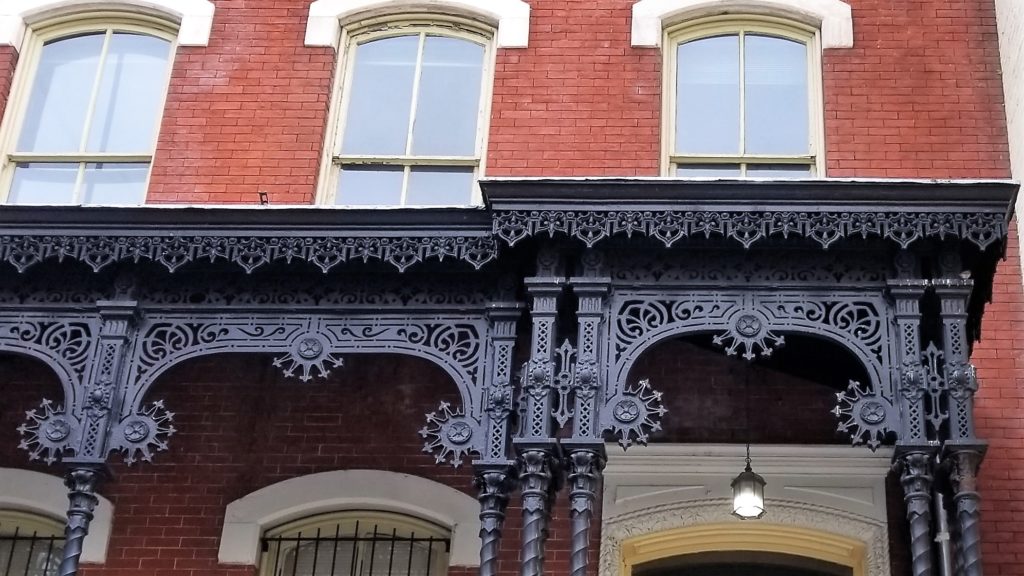
October 2018
The house’s exterior details, such as cornice and ironworks, along with interior elements, such as doors and moldings, may be found in such catalogues. Although mass-produced, the quality of these materials appears to be in keeping with the standards of craftsmanship found during the antebellum period, and in keeping with the relatively high social status of the original builder, Joseph P. Winston.

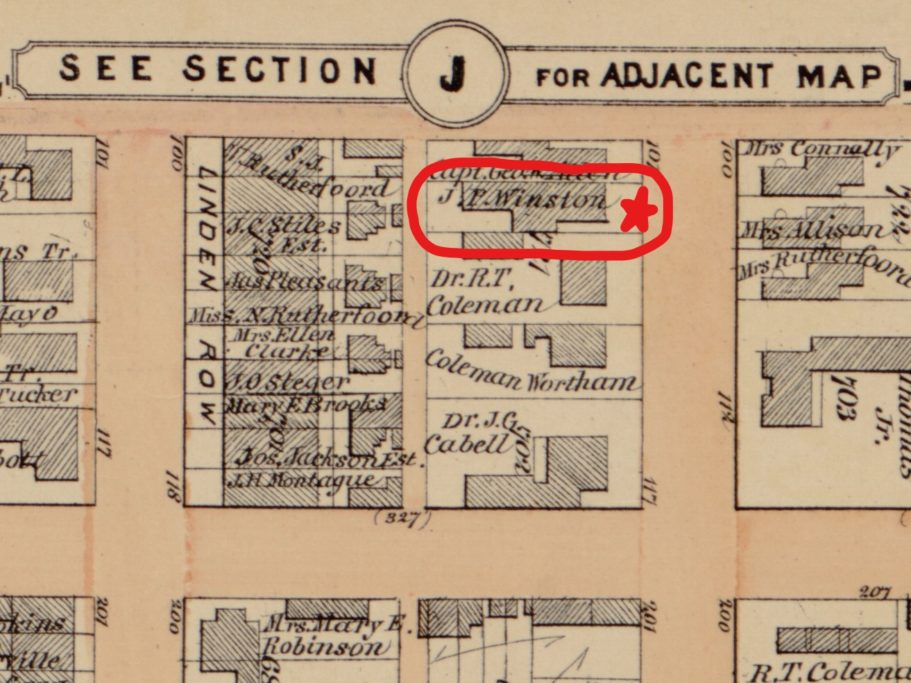
(LOC) — Beers Illustrated Atlas of the Cities of Richmond & Manchester, 1877— Plate K
Not only is the house significant as an artifact of the city’s architectural history but also as a document of the city’s changing residential trends. When erected by Joseph P. Winston in 1873-4 on Land purchased from the estate of Richard C. Worthham in 1872, the neighborhood was occupied by affluent professionals and merchants.

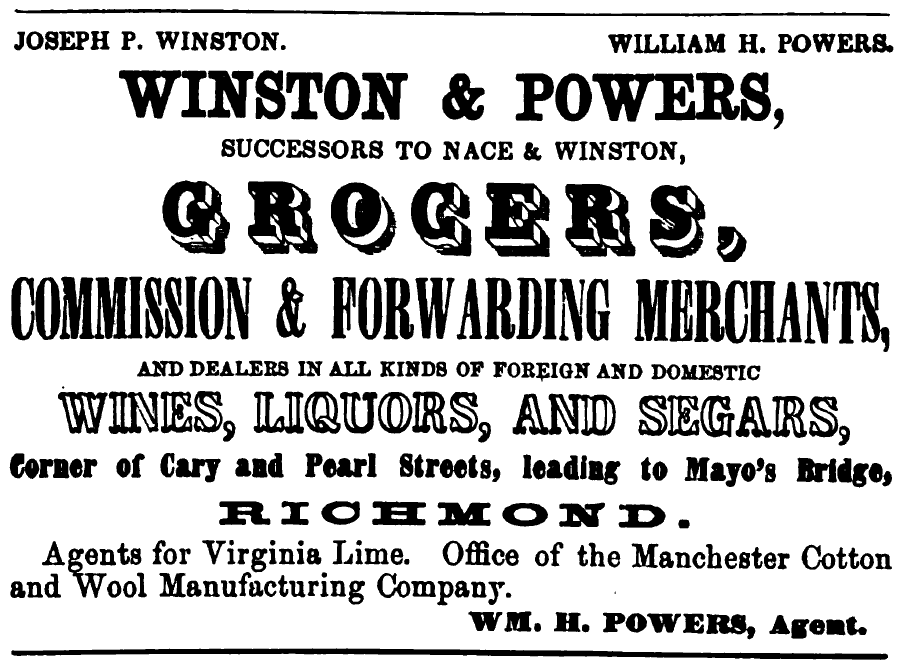
[SGSVA] — 1855 advertisement for Winston & Powers, which would eventually become Joseph P. Winston Co. — note the Pearl Street address
Joseph Winston, probably from Hanover County, came to Richmond around 1850 and conducted a successful wholesale grocery and commission business in the city until his death in 1880. Winston’s choice of an address on East Grace Street was most likely influenced by its location near his business, as well as the homes of his associates. (VDHR)
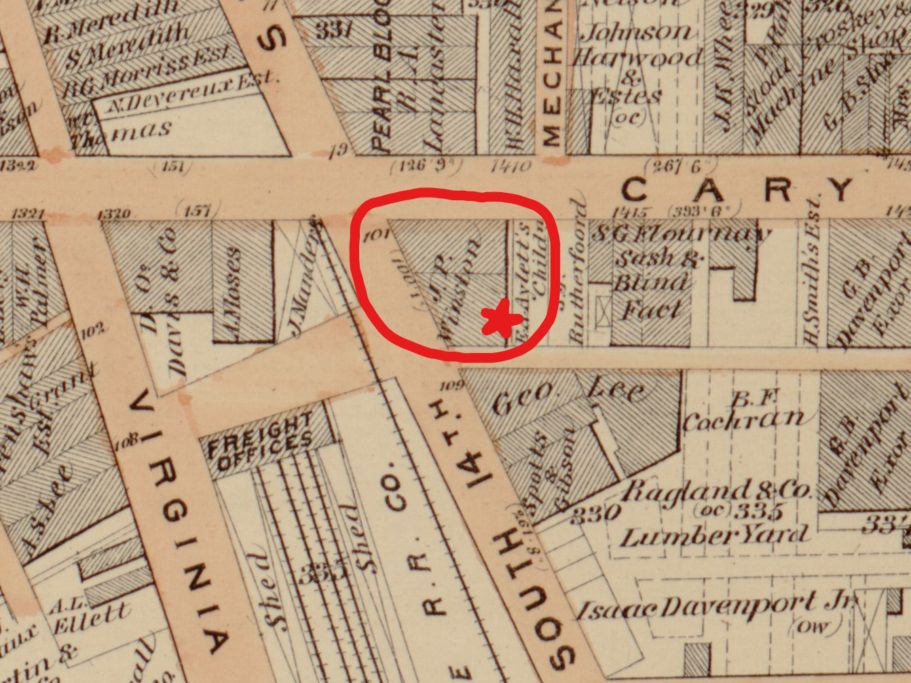
(LOC) — Beers Illustrated Atlas of the Cities of Richmond & Manchester, 1877— Plate L — showing location of Joseph P. Winston Co.
Not a bad guess. According to Google Maps, 101 South Fourteenth Street, where Joseph P. Winston Co. was located, is either a 19-minute walk or a 9-minute ride by bike horse, a mere 1.2 miles.

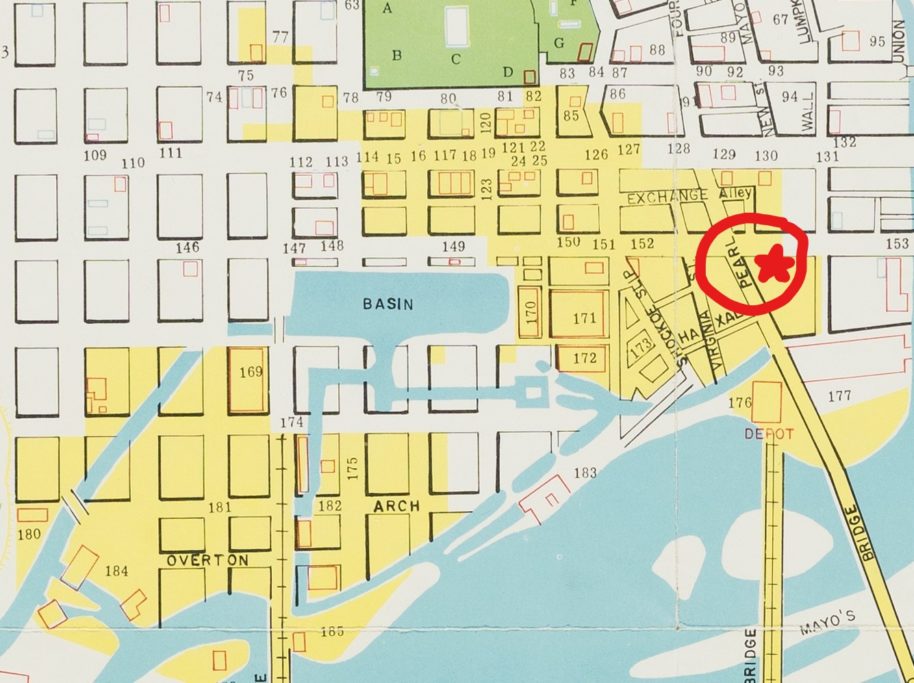
[Library of Virginia] — Centennial Map of the City of Richmond, Virginia 1861-65 — showing original location of Winston’s business at Cary & Pearl Streets within the Burnt District
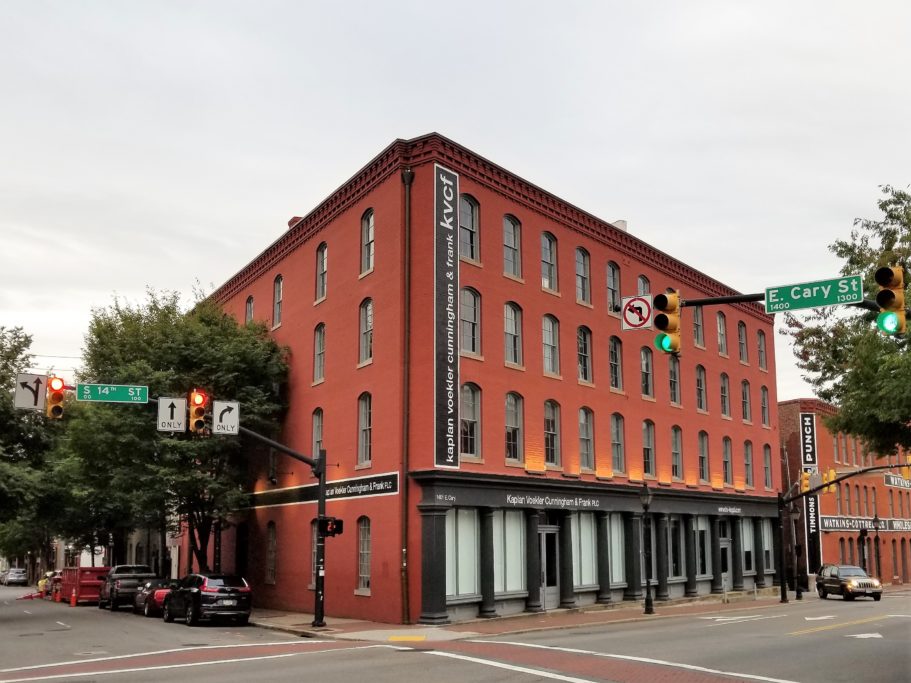
October 2018 — former location of Joseph P. Winston & Co.
Still, even defeated Confederates have to eat, so it’s no surprise that Winston was able to get back on his feet and rebuild on the same location by 1870. The mammoth four-story commercial warehouse that he constructed is still with us today, replete with iron fronts and beautiful brick corbelling at the cornice.
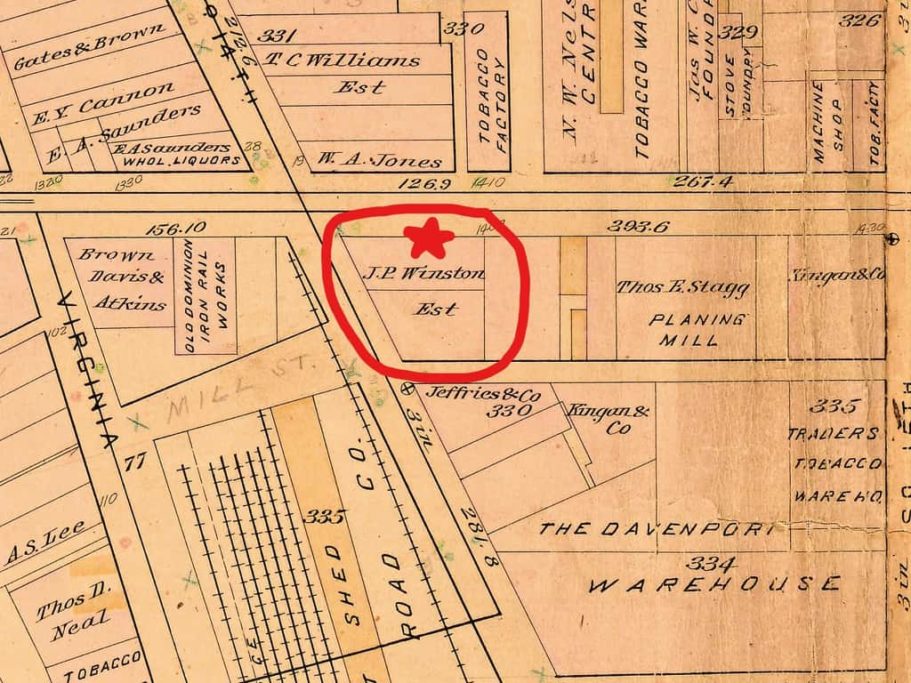
(VCU) — 1889 Baist Atlas Map of Richmond — Plate 2 — showing J. P. Winston Estate
Following the death of her husband, his wife, Lelia Winston and her son Donald, executrix and executor of Joseph’s estate, disposed of all of the stock of goods from the business, including groceries, liquors, and tobacco supplies. (Chronicling America) This did not include either of the two properties. She did not sell the house on Grace Street until 1903, despite relocating to Jefferson County, Kentucky in 1895. Likewise, she held onto the Fourteenth street building as late as 1889, no doubt for rental income. (VDHR)

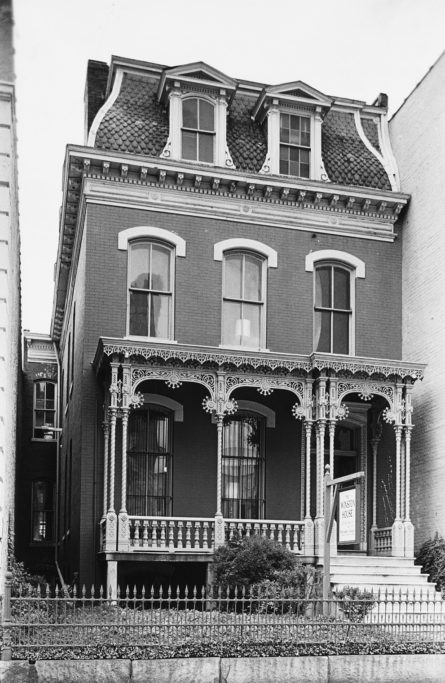
(VDHR) — 1979 nomination photo
The house then had a succession of owners until its acquisition in 1929 by the Joel family, the founders of the Richmond Art Company next door, and present owners of both properties. Both structures serve as a statement of changing trends in Richmond’s commercial development – the Winston House as the home of a Richmond merchant, built in a residential neighborhood gone commercial, and the Richmond Art Company, designed by the Richmond architect Duncan Lee, a commercial structure that stands in a neighborhood that continues to undergo redefinition. (VDHR)
(Joseph P. Winston House & Joseph P. Winston & Company are part of the Atlas RVA Project)
Sources
- [SGSVA] Statistical Gazetteer of the State of Virginia. Richard Edwards. 1855.


Must-See RVA! is a regular series
appearing on rocket werks – check it out!

