Downtown
RVA Legends — American Locomotive Company
A look into the history of Richmond places and people that have disappeared from our landscape.

AKA, Metropolitan Iron Works, Richmond Locomotive Works, Richmond Locomotive & Machine Works
Hospital & North Seventh Streets
Built, 1883
Demolished, after 1933
Okay, this is a little complicated, but this is not Richmond Locomotive & Machine Works, whose buildings still stand at 1331 North Boulevard.
The Richmond Locomotive & Machine Works grew out of Tredegar Iron Works just after the Civil War. The firm began in 1865 in a machine shop owned by William E. Tanner, who was joined by Alexander Delaney from Tredegar. The resulting firm was called the Metropolitan Iron Works, and in 1865 they began to manufacture steam boilers, stationary engines, and saw mills.

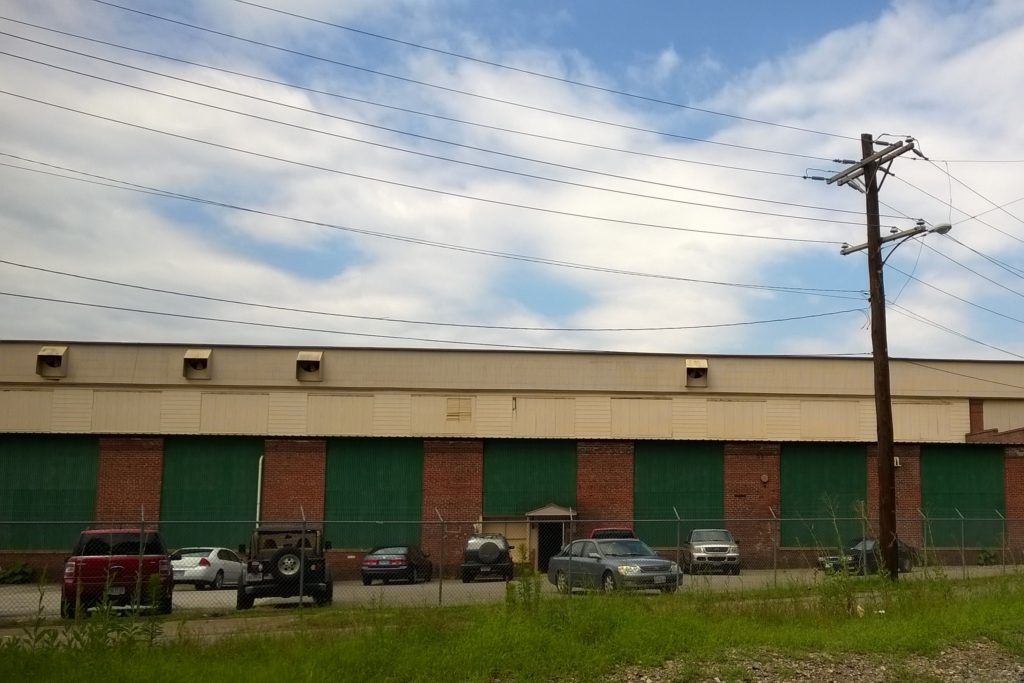
June 2016 – Valley Road looking NW
The Metropolitan Iron Works prospered and was renamed Tanner & Delaney Engine Co. in 1882. One year later fire destroyed the original plant. The firm immediately rebuilt on a new twelve-acre site in Shockoe Valley, then just outside the City of Richmond in Henrico County. The land had been purchased two years earlier from James Dooley, and held for future expansion. The firm prospered in their new facilities and added a line of steam locomotives in 1886, including the new steam dummies.

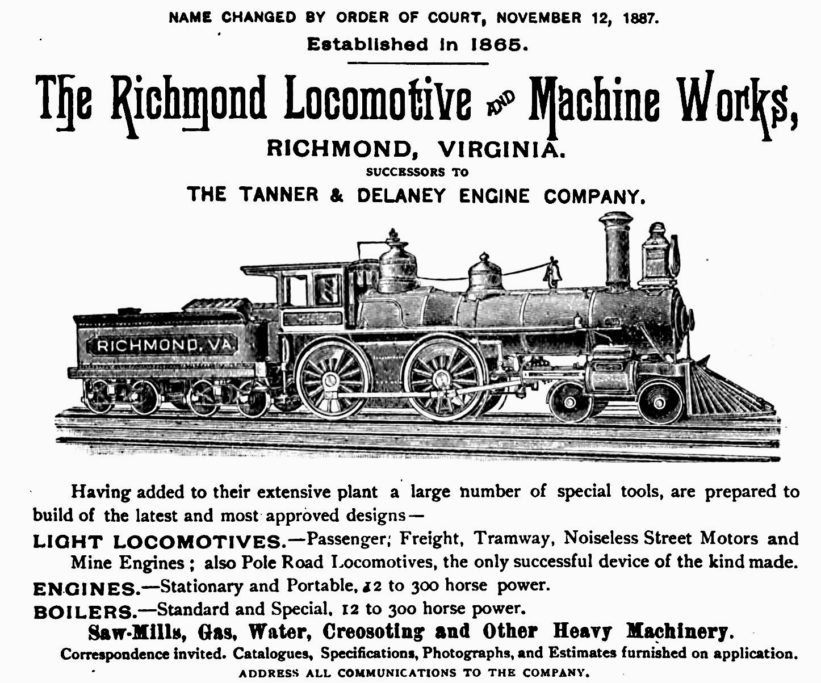
(Old Vintage Designs)
Tanner & Delaney borrowed heavily in the mid-1880s to finance their expansion. Unable to repay the loans, they were ousted from control of their company late in 1887 by a group of Richmond bondholders that included James Bryan, publisher of the Richmond Dispatch. William Trigg was installed as president in that year, but Joseph Bryan replaced him as president in 1898. As a result, the firm was renamed the Richmond Locomotive & Machine Works. The firm continued to produce steam boilers and sawmills, but in the 1890s, began to produce a variety of locomotives. To reflect this change in production, in 1900 the firm’s name was shortened to the Richmond Locomotive Works. By that time the Richmond Locomotive Works was the largest employer in Richmond, with some 5,000 employees.

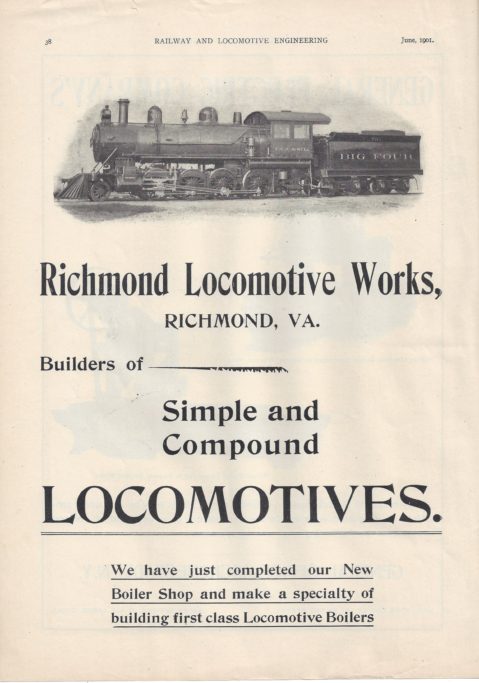
(rocket werks)
In 1900, the Richmond Locomotive & Machine Works shortened its name to the Richmond Locomotive Works, reflecting its emphasis upon locomotive construction. At the time it was the largest employer in Richmond, and a productive manufacturer. Locomotive manufacturing had become a big business, however, and small, independent producers like Richmond had little chance to compete on a national level. Locomotive production was dominated by the massive Baldwin Locomotive Works, based in Philadelphia, and the Lima Locomotive Works of Lima, Ohio.

(Wikipedia)
In order to compete, several independent locomotive manufacturers, including the Richmond Locomotive Works, merged into the American Locomotive Company (ALCO) in 1901, becoming the second largest locomotive producers in the country. There were eight plants in the new conglomerate: the Brooks Locomotive Works in Dunkirk, NY, the Cooke Locomotive and Machine Works in Paterson, NJ, the Dickson Manufacturing Company in Scranton, PA, the Manchester Locomotive Works in Manchester, NH, the Pittsburgh Locomotive and Car Works in Pittsburgh, PA, the Rhode Island Locomotive Works in Providence, RI, the Richmond Locomotive Works in Richmond, VA, and the Schenectady Locomotive Works in Schenectady, NY. The Richmond plant was the southernmost, catering mostly (but not exclusively) to the southern market. By the time the works were first closed in 1926, it had produced 389 locomotives at the Richmond plant – 682 including those manufactured under the Richmond Locomotive Works name – for distribution across the United States and the world.
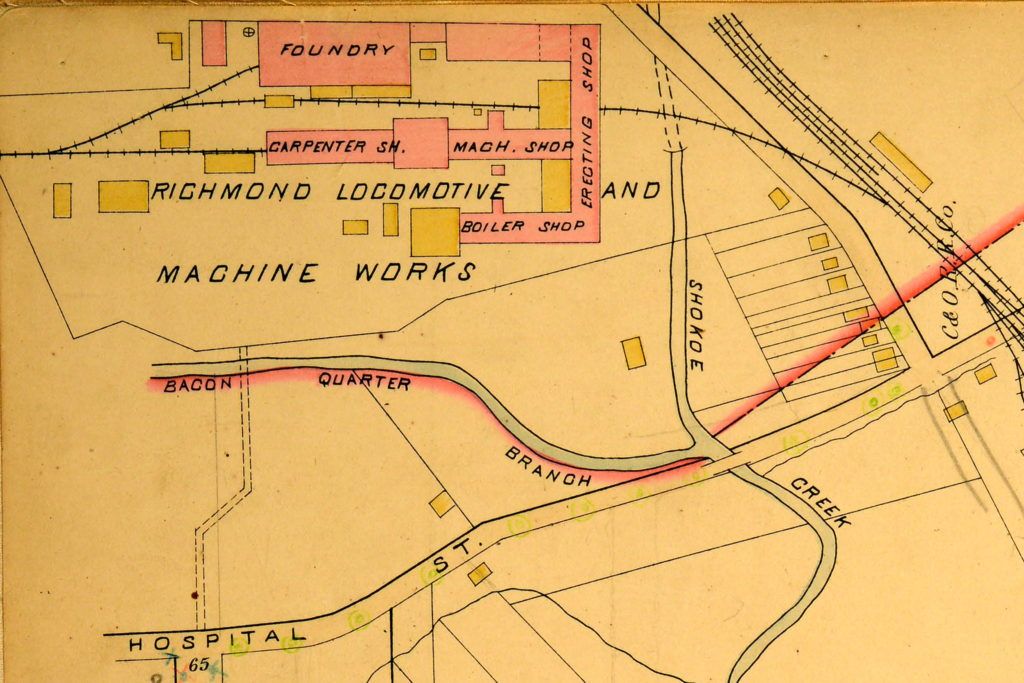
(VCU Libraries) – Baist Atlas of Richmond, VA (1889)
Just six years after the merger, ALCO began to close some of the smaller works. The Rhode Island plant was the first to close; opened in 1866, it was shuttered in 1907. The Dickson works followed two years later; created in 1862, it was closed in 1909. Rogers, the oldest of all the plants owned by ALCO, was not immune to closure; it was closed in 1913 after remaining in operation since 1837. The Manchester plant was closed in 1913. Similarly, the Pittsburgh plant, which had operated since 1867, was shut down in 1919. [VDHR]

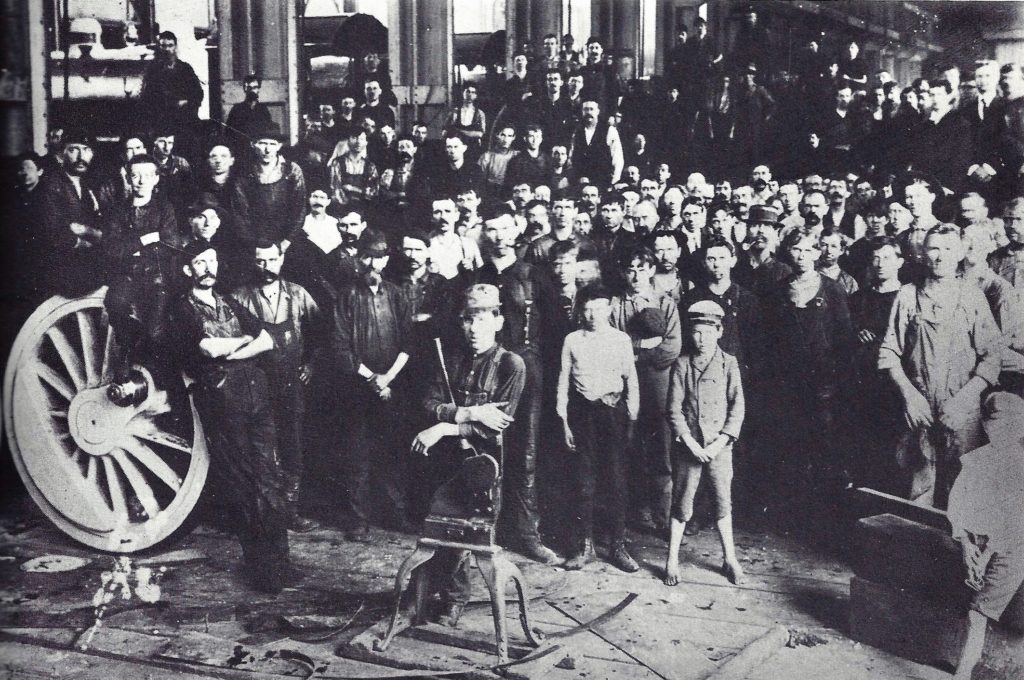
[COC] – Workers pose in the mid-1890s
It was not until the presidency of Woodrow Wilson that child labor laws were passed making it illegal to hire children at the ages of the boys shown here in the front rows. [RIH]
By 1918, the Richmond works’ Columbus K. Lassiter was assigned to ALCO’s main offices in the Hudson Terminal in New York City, which was seen by workers in Richmond as a positive step that would protect their interests. Lassiter resigned in 1922, however, and ALCO’s corporate policy favored centralization.

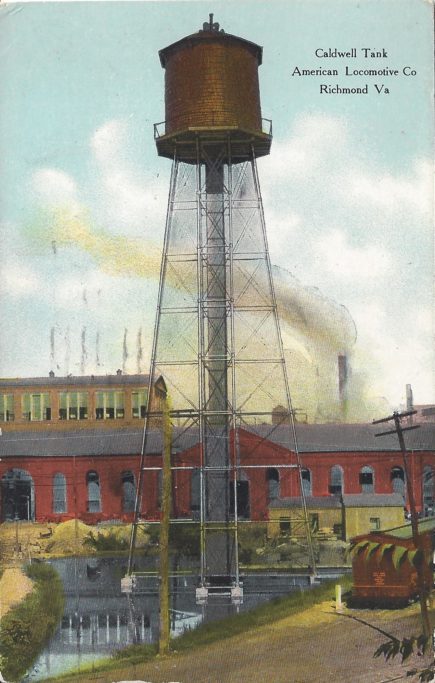
(rocket works)
In January 1927 the Richmond works were closed. They re-opened in the spring, and operated again for several months, but were permanently closed by the end of the year.54 The last of the smaller facilities, the Brooks works – which had operated since 1869 – was closed shortly after the Richmond facility. The corporate structure of the Richmond works was dissolved in 1929. The Shockoe Valley plant was listed in the Richmond city directory as late as 1932-33, even though production there had ceased.
The exact date of the first buildings of the Richmond Locomotive Works on the North Boulevard site is uncertain. It is clear, however, that by the publication of the 1908 Sanborn Fire Insurance map the site was well developed. [VDHR]
Sources
- COC – Century of Commerce, 1867-1967. James K. Sanford.
- Old Vintage Designs
- VCU Libraries – Baist Atlas of Richmond, VA (1889).
- VDHR
- Wikipedia


RVA Legends is a regular series appearing on rocket werks – check it out!


