Government
Several Virginia Election Day outcomes smashed polling and pundit predictions
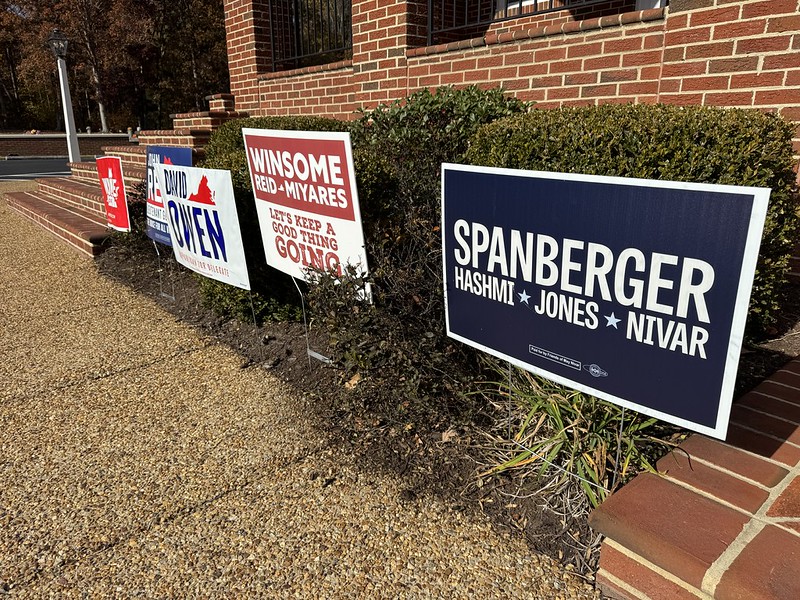
Democrats fared far better in the gubernatorial election than polls and pundits predicted leading up to Election Day.

By Hayden Braun
Democrats fared far better in the gubernatorial election than polls predicted leading up to Election Day.
Emerson College Polling, the Institute for Policy and Opinion Research at Roanoke College, L. Douglas Wilder School of Government and Public Affairs at Virginia Commonwealth University and the Wason Center for Civic Leadership at Christopher Newport University released surveys in an attempt to measure voter sentiment throughout the campaign.
Democratic candidate and now Gov.-elect Abigail Spanberger maintained a consistent lead over Republican candidate Winsome Earle-Sears in all polls, occasionally holding leads in the double-digits.
Once polls closed and the votes were counted, Spanberger’s victory was decisive. Several media outlets called her victory under an hour after polls closed, according to an X post by NBC News.
Spanberger won approximately 57.3% of the vote to Earle-Sears’ 42.4%, a 14.9 percentage point difference. The final numbers were considerably wider than any pre-election poll had projected.
Democratic candidate and now Lt. Gov.-elect Ghazala Hashmi led Republican opponent John Reid in the Christopher Newport and VCU polls, but within the margin of error. Hashmi won by over 11 points, according to unofficial election results.
Democratic candidate and Attorney General-elect Jay Jones initially polled slightly higher than Republican candidate and current Attorney General Jason Miyares, but after the text scandal broke, Miyares closed the gap. The margin of error did not give either a strong advantage. Jones polled higher among those who voted early.
Jones won on Election Day by over six points. Many anticipated that Miyares, who received the most votes of all the Republican candidates on the top ticket, would win and create a split ticket.
Stephen Farnsworth, a political science professor and director for the Center of Leadership and Media Studies at the University of Mary Washington, explained surveys as snapshots in time rather than crystal balls.
“You have to get a representative sample of the group of people that you’re trying to understand,” Farnsworth said. “What’s important beyond the number is how you contact them. Oftentimes, people use random digit dialing or something like that to give people a representative sample of the survey.”
Professionally done surveys “still have potential opportunities for error,” and timing can also affect results, Farnsworth added.
“If you call people on, say, a Saturday night, you’re likely to get a lot of people who are parents,” Farnsworth said. “If you call on Sunday, you might have fewer people who go to church. People going to church, the more religious people, wouldn’t be in your sample.”
Farnsworth said that even the best-designed surveys can produce odd results.
“You can do everything right and still get a weird result,” Farnsworth said. “At best, surveys are a snapshot at the moment of the poll … a rough approximation of the larger sample.”
The polls also asked about broader trends among the electorate, including key issues and sentiment of current leaders.
The VCU poll posted on Oct. 21 surveyed 842 people across Virginia. The poll found that rising cost of living (27%), immigration (14%) and reproductive rights (12%) ranked as the most important issues among likely voters.
The Wason poll posted on Oct. 27 identified threats to democracy (18%), inflation and cost of living (18%), health care (11%) and immigration rights (9%) as the top concerns for Virginians.
Pundits also seemed surprised when Democrats picked up 13 House of Delegates seats, boosting their majority to 64. Most predicted the party would remain in control of the lower chamber, but there were some surprise flips such as Del. Bobby Orrock’s defeat which ended over 30 years of service.
Election Day Voters at the Polls
VCU Capital News Service went to over 20 polling places in four counties and two cities to speak with voters on Election Day.
Voters frequently said that cost of living, government shutdown and health care were what brought them out to vote. Few offered immigration as a key reason given for voting. Other reasons given were LGBTQ+ rights and the direction that MAGA Republicans are headed.
“I used to be a Republican myself, but I don’t like the way the party’s gone under the Trump guidance,” said a voter at Swift Creek Baptist Church who identified himself only as Paul. “I’ve kind of switched allegiance right now until the Republican party comes back more to the center.”
Richmond voter John Green said he also voted for a full Democratic ticket because of the direction the Republican party is headed.
“Because they were not willing to definitively distance themselves from the president and his politics, I couldn’t vote for any Republican person, even if I thought them of good character and with solid ideas for politics,” Green said.
Retiree Vicki Smith in Petersburg said border security and economy were her top issues. She thinks Gov. Glenn Youngkin has done a good job and Jones should have stepped down. Another top issue on her mind is how the government shutdown affects her former colleagues at Defense Supply Center Richmond.
“I’m retired and I feel like it’s really a shame that our leadership can’t get their acts together and work together to you know make sure that they’re there for the people, and we shouldn’t be going through shutdowns,” Smith said.
Voters at George Washington Carver Elementary School in Richmond, like lifelong city resident Angela, said the rising housing costs were their top issue.
“The cost of living is insane. I was born and raised in this city, so I’ve seen ups, downs, lefts, rights,” she said. “I remember back when apartments were $500 a month.”
Overall Republican turnout was lower than in 2021, according to the Virginia Public Access Project. Youth turnout was higher this election, based on exit polls and a survey of college-area precincts.



Photos: LEGO Holiday Workshop Clicking Together this Weekend

Get Ahead on Holiday Shopping this Saturday at Tip of the Season Art Market

Photos and Game Summary:

Bike Ride with Friends to Fight Hunger for Cranksgiving

Album Cover Sticker Art Show Opens Tomorrow

Flying Squirrels bring free Squirrel-O-Ween trick-or-treating to CarMax Park on Oct. 30

Steely Dan tribute and Louisiana zydeco close out October at the Cultural Arts Center at Glen Allen

Texas Inn marks 91 years with 91-cent hot dogs on Tuesday

RPD Reporting Arrests Made, Several Vehicles Recovered in Honda Theft Ring

Maymont’s Garden Glow opens Wednesday with a Firefly Field and a longer laser tunnel